Financial RSS Feeds
https://www.investing.com/rss/news.rss
https://cointelegraph.com/rss

Need to know what happened in crypto today? Here is the latest news on daily trends and events impacting Bitcoin price, blockchain, DeFi, Web3 and crypto regulation.

The stablecoin payments company previously disputed reports that its US listing had been delayed.
https://www.coindesk.com/arc/outboundfeeds/rss/
https://cryptobriefing.com/feed/
Binance's focus on traditional assets in futures trading could blur lines between crypto and traditional finance, impacting market dynamics globally.
The post Binance lists 227 futures pairs in 2026, with most tracking traditional assets appeared first on Crypto Briefing.
BNB Chain's Q3 growth in tokenized assets highlights its emerging role in DeFi, though concentration risks and market volatility remain concerns.
The post BNB Chain tokenized assets surge in Q3 as RWA supply reaches $4.96B appeared first on Crypto Briefing.
https://bitcoinist.com/feed/
Institutional appetite faded fast. Spot Bitcoin ETFs in the US saw roughly $228 million of net withdrawals between October 12 and 16, following $681 million the week before, for a two-week total of $909 million. That is the biggest pullback since April. Price action matched the mood: Bitcoin slid under $82,000, with about $771 million in positions liquidated in a single day earlier in the week, then nearly $1 billion more on October 15 as Bitcoin, Ether, and XRP dropped together. BTC finished the week near $81,400.
TL;DR
- US spot Bitcoin ETFs lost $909 million over two weeks, the heaviest institutional selling since April, while nearly $1 billion in leveraged positions was wiped out on October 15.
- Charles Schwab opened Bitcoin and Ether trading to eligible clients even as an OCC review found all nine major US banks can cut crypto firms off.
- Europe elevated USDC to “significant” status under MiCA, leaving Tether on the outside.
- MSCI could drop Strategy and Metaplanet from its indexes by November 30.
Europe Crowns USDC, Leaves Tether Waiting
The European Banking Authority labeled Circle’s USDC the first “significant” e-money token under MiCA. Starting November 12, the stablecoin moves from national supervisors to direct EBA oversight, bringing tougher capital rules and stronger redemption duties. Circle pursued an EU license and secured one, whereas Tether’s USDT skipped the process and remains outside the framework. ESMA has also set a three-month window for EU platforms to unwind non-compliant stablecoin exposure, so exchanges serving the bloc face an obvious choice.
Schwab Welcomes Crypto While Big Banks Hold The Gate
Charles Schwab rolled out Schwab Crypto to all eligible US clients, offering Bitcoin and Ether at a 0.75% fee per trade. With around 35 million brokerage accounts, the move places crypto beside stocks and retirement savings in an app millions of Americans already use.
Yet the OCC found that all nine of the largest national banks have internal policies that let them restrict or deny services to digital-asset issuers, exchanges, and administrators. The review mandates nothing, but it puts the issue on the record and hands lawmakers and regulators documented grounds for action should de-banking persist.
MSCI approved criteria that could eject Strategy and Metaplanet from its equity benchmarks. The final roster arrives November 11, with any removals taking effect after the November 30 close. Passive funds tracking those benchmarks would then need to dump the shares. Both firms keep their valuations tied to Bitcoin held on their balance sheets, which sits awkwardly with how MSCI judges conventional businesses.
Policy Vacuum And A Perpetuals Push
Patrick Witt, the final adviser steering the White House digital assets office, has left with no successor named, just as the SEC, CFTC and OCC all juggle active crypto rulemakings.
Meanwhile, SEC Trading and Markets Director Jamie Selway said five CFTC-registered exchanges have applied to become security futures exchanges, and at least four could list securities perpetual futures before the year ends. Those no-expiry contracts on individual stocks or indexes are popular offshore but do not yet exist in regulated US form.
Bitcoin had a bumpy stretch. After reaching roughly $83,800 on October 13, the flagship asset slid to a weekly trough near $80,100 two days later, as traders reacted to a hotter-than-forecast inflation reading and a sharp pullback in AI-linked stocks.
TL;DR- Bitcoin dipped to about $80,100 before recovering toward $81,000 as hot inflation data and a tech sell-off weighed on risk assets.
- Crypto investment products lost $593.3 million in a week, with Ethereum funds hit hardest.
- MSCI’s new index rules could push Strategy and other bitcoin treasury companies out of its benchmarks.
- USDC gained EU “significant” status, while the White House lost its crypto adviser and the CLARITY Act stays stuck.
Bitcoin Slips, Then Steadies
Dip buyers emerged over the weekend, and BTC now changes hands near $82,000, about 0.6% lower over seven days. Bitcoin’s share of the overall market stayed between 59.7% and 60.4%. The total crypto market capitalization sits near $2.76 trillion, down 2.1% on the week, while the fear and greed index cooled from 56 to a neutral 49.
Digital asset investment products shed $593.3 million. Ethereum-focused funds accounted for $320.1 million of that, versus $228.4 million for Bitcoin products. Ether itself slipped from a $2,489 open to a low of $2,336 on Sunday and now trades near $2,403, a 3.4% weekly loss. Among other majors, XRP fell 4.7% and Solana lost 3.5% ahead of its Alpenglow upgrade, which Anza scheduled for October 21 and says will cut finality from about 12.8 seconds to roughly 150 milliseconds.
Still, BlackRock’s crypto ETF assets swelled 63% in the third quarter to $79.6 billion, though that remains 23% beneath the level of a year ago. The asset manager also filed for an iShares Bitcoin Managed Protect ETF, which would target upside exposure to IBIT with a measure of downside cushioning.
Treasury Companies Face An Index Showdown
MSCI confirmed a new screen for “non-operating” companies starting November 30, ending the temporary shield for firms holding more than half their assets in digital assets. A final list lands November 11. MSCI has named no one, but reports point to Strategy and Metaplanet. JPMorgan estimates Strategy could see up to $2.8 billion in outflows, and Michael Saylor has labeled the rule discriminatory.
The buying has not stopped. Strategy added 267 BTC, lifting its holdings to 848,517 BTC. Strive picked up 4,045 BTC, and BitMine acquired 12,535 ETH, pushing its stash beyond 6 million ETH.
Banks And Regulators Keep Building
The European Banking Authority designated Circle’s USDC as the first “significant” e-money token under MiCA, placing it under direct supervision from November 12. JPMorgan extended its JPM Coin deposit token to Ethereum, and Mastercard unveiled a multi-currency account for fiat and stablecoins, built on infrastructure from BVNK, which it acquired for about $1.8 billion. Allium data show stablecoin payments of roughly $482 billion in the first nine months of the year, up 45%.
In Washington, crypto adviser Patrick Witt is departing with no replacement named. The CLARITY Act has sat idle since failing a 49–50 cloture vote on September 15, and Congress is out until after the November 3 midterms.
https://cryptoslate.com/feed/
Bitquery measured outside buying within roughly 1.3 seconds at 53% versus 52% in samples that predate the final 200ms reduction.
Read the full story on CryptoSlate
Understand the crypto stories that matter and what to watch next. Get The Catalyst in your inbox
The Foundation’s proposed rewrite would end cohort elections and seat nominees unless a veto reaches 20% of active votable OP supply.
Read the full story on CryptoSlate
Understand the crypto stories that matter and what to watch next. Get The Catalyst in your inbox
https://ambcrypto.com/feed/
https://beincrypto.com/feed/
Ed Yardeni, president of Yardeni Research, says air is leaving the artificial intelligence (AI) bubble without a burst. He says bond investors are rationing capital to AI borrowers, while Elon Musk warns 200-plus AI cloud firms could fold.
Ari Wald, Oppenheimer’s head of technical analysis, also rules out a collapse. However, he sees lower highs in small caps and credit that could weigh on holders of both.
Can the Bond Market Police AI Spending?
Yardeni says bond investors are grading AI borrowers more sharply, and faster than credit rating agencies. He sees that discipline as the healthiest outcome.
He summed up the view during the segment.
“I think air is coming out of the bubble without the bubble bursting, which is the best solution to all these concerns.”
Ed Yardeni, CNBC
Musk issued an AI cloud warning over the weekend. He said lenders have largely cut off firms whose only business is AI data centers.
Yardeni concedes some AI companies will fail. Still, he expects stronger players to bail out weaker ones.
Anthropic filed its public registration for an initial public offering (IPO) on Monday. Chip, memory and AI cloud stocks were higher during the segment.
Yardeni says Anthropic could use IPO proceeds to help a struggling AI cloud provider. However, the filing lists general corporate purposes and cites no commitments for material acquisitions or investments.
Does Weak Breadth Still Warn of a Top?
A chart shown on air flagged days the S&P 500 fell 1% or more while more stocks rose than fell. Historically, seven of the 13 such days since 1990 came in 1999 and 2000.
Wald still expects a year-end rally, citing oversold conditions. However, he says lower highs in small caps, market leadership and credit could undermine it. That could set up a market reset in 2027.
Meanwhile, global credit spreads, the extra yield lenders demand over safe bonds, have climbed to their highest since May 2025. Anthropic’s listing will test whether fresh capital backstops weaker AI borrowers, as Yardeni expects. Rising defaults would undercut his read.
The post Yardeni Says AI Bubble Is Deflating, Not Bursting, as Bond Market Steps In appeared first on BeInCrypto.
Microsoft is offering voluntary buyouts to about 60,000 employees. The time-limited program covers staff at level 70 and below in the US, Canada, India, and the UK.
The offer arrives just before Microsoft reports fiscal first-quarter results on Wednesday. Investors will use that report to judge whether the company’s AI spending is starting to pay off.
Microsoft Buyouts Reach Copilot and Xbox, but Not Security Teams
Chief People Officer Amy Coleman announced the program in a memo to staff. The eligible pool equals more than a quarter of the 223,000 full-time staff Microsoft reported on June 30.
A source told Reuters that teams in AI experiences, Copilot, Xbox, and Windows + Devices qualify. Marketing, commercial business, and security teams sit outside the offer.
Coleman presented the program as an option for employees already weighing a move.
“This offer gives eligible employees who may be considering a future outside the company a new choice to make that transition now with support. It also gives participating organizations another way to adapt their workforce to changing needs,” the memo read.
The memo lists no payment amounts. Employees reportedly have until early December to decide, with exits planned for the end of the year.
It marks the third workforce move of 2026. Microsoft offered buyouts to about 9,000 US employees earlier this year, then cut 4,800 jobs in July.
Follow us on X to get the latest news as it happens
Wall Street Has Punished Microsoft Beats Before
Microsoft reports fiscal first-quarter 2027 results after Wednesday’s close. BeInCrypto’s preview puts estimates near $4.71 in earnings per share on about $90.63 billion in revenue.
Microsoft shares closed 1.54% higher at $532.60 on Monday. Year-to-date, the stock is up 10.3%.

Beating estimates may not be enough. Microsoft topped forecasts in January, yet its shares fell 10% to $433.50 the next day. The drop erased $357 billion, the company’s largest one-day loss in market value.
Meta faced similar pressure in July. AI infrastructure spending, legal charges, and severance costs cut its operating margin to 31% from 43%.
Microsoft’s own spending keeps climbing. The company has forecast $175 billion in capital expenditure for calendar 2026.
Wednesday’s report will test Azure against Microsoft’s guidance of 44% to 45% growth. The call may also show whether a buyout charge lands in the December quarter.
Subscribe to our YouTube channel to watch leaders and journalists provide expert insights
The post Microsoft Opens the Exit Door to 60,000 Staff Days Before Earnings appeared first on BeInCrypto.
https://cryptonewsz.com/feed/
The crypto market braced for heightened volatility this week as Bitcoin’s price titters at the $80,000 psychological level ahead of the U.S. Federal Reserve’s interest rate decision. Following a short uptick of 0.07%, the global cryptocurrency market cap reaches $2.69 trillion as traders remain cautious of risk assets and follow a “wait-and-see” approach.
Crypto Market Awaits FED Decision and Warsh Speech
Within a week, the Bitcoin price dropped from $84,000 to $80,000, registering a loss of 4.74%. The pullback was triggered by a sell-off in U.S. technology stocks, renewed geopolitical tensions, and a wave of liquidation in crypto derivatives markets.
However, the coming week could continue to see notable volatility as investors brace for the Federal Reserve’s upcoming interest rate decision, critical U.S. inflation metrics, and a massive options expiry.
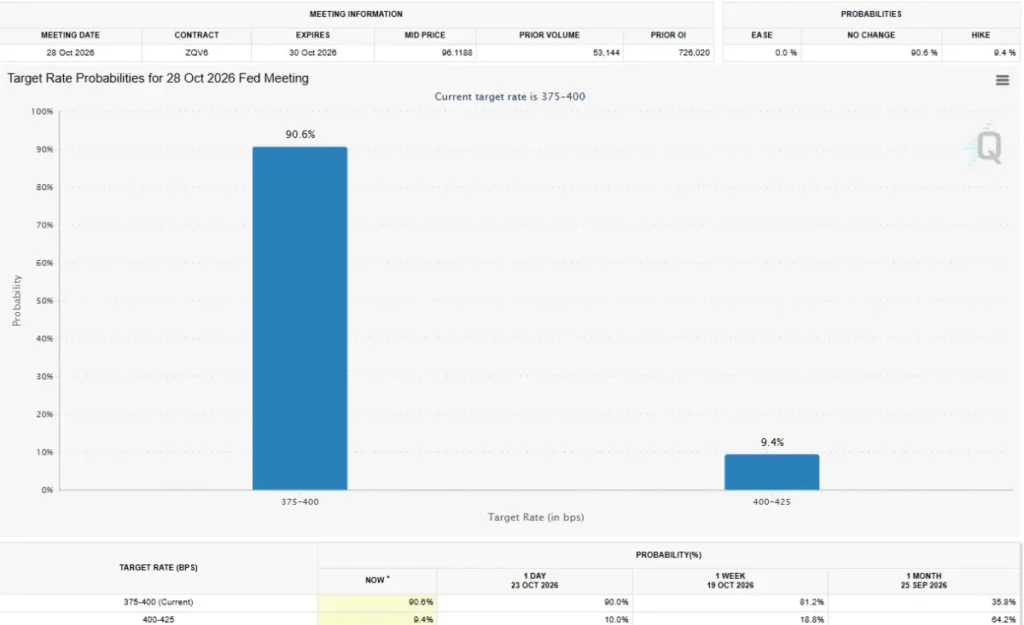
The Federal Open Market Committee (FOMC) is scheduled to meet on October 27-28. According to the CME FedWatch Tool, the market has priced in a staggering 90.6% probability that the central bank will hold the interest rate steady at the 3.75-4.00% target range.
Following the 25-basis-point rate hike in September—the Fed’s first increase in over three years—the potential rate pause is widely expected. Therefore, the upcoming Fed interest rate decision could already be priced in the digital market, and the next immediate market-moving catalyst lies in the forward guidance delivered by Fed Chair Kevin Warsh.
If the central bank adopts a hawkish tone, it would cement market expectations for another 25-basis-point interest rate hike at the final policy meeting in December. Prolonged high interest rates risk driving 10-year Treasury yields above 5%, prompting institutional capital to pivot away from spot crypto assets toward risk-free yields.
Sticky PCE Inflation Looms Large
In addition, the U.S. The Bureau of Economic Analysis will release the Personal Consumption Expenditure (PCE) data in October 2029. PCE is the Fed’s preferred index to gauge real consumer price trends.
Economists project the headline PCE inflation to rise to 3.6% year-on-year, compared to the 3.4% recorded in August. Meanwhile, the Core PCE, which excludes the volatile food and energy sectors, is forecasted to rise by 3.1% annually and 0.3% month-over-month. A hotter-than-expected print would signal persistent inflation pressure, giving the Fed a green signal to keep interest rates elevated in the next meeting.
| U.S. SEPTEMBER PCE INFLATION FORECASTS | |
| Metric | Expected Estimate |
| Headline PCE (YoY) | 3.6% |
| Core PCE (YoY) | 3.1% |
| Core PCE (MoM) | 0.3% |
Bitcoin Price Prepares Next Rebound With Flag Pole Pattern.
Since late September, the Bitcoin price has been trading in a narrow range between $86,500 and $79,500 on the daily chart. From a technical perspective, this consolidation represents a potential bull flag pattern that could bolster buyers to replenish the exhausted bullish momentum.
With a 0.2% uptick, the Bitcoin price today sits at the lower trendline of the flag pattern near $80,000. If the buyers continue to hold this pattern, the price of BTC could jump roughly 7.5% up to challenge the flag’s resistance trendline near $86,000.
An upside breakout from this resistance will accelerate the bullish momentum in price, and bolster Bitcoin to target overhead $98,000 and $106,286.
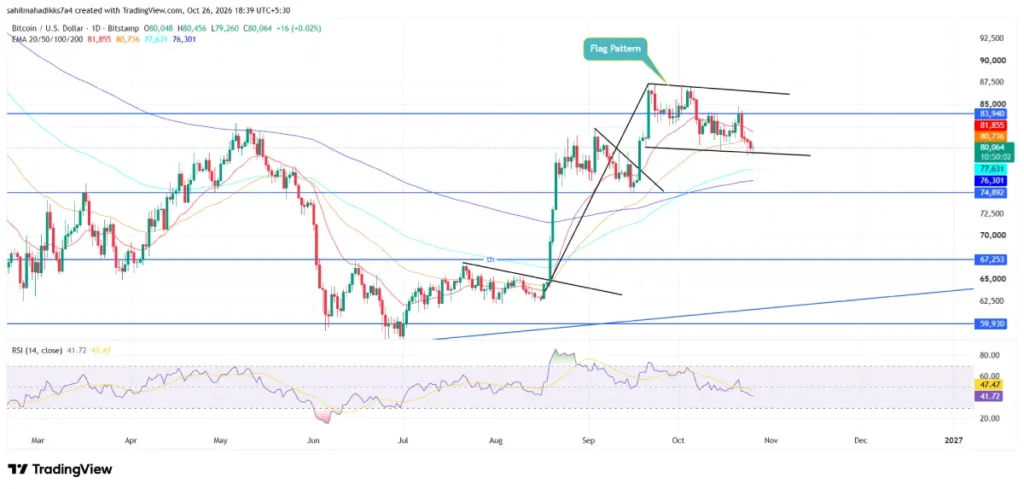
The coin price also retains its position above the 100-and-200-day exponential moving averages (EMAs), signalling a broader bullish sentiment in the crypto market.
On the contrary, if the Bitcoin price slips below the $80,000 support, the bullish thesis would be invalidated, and sellers could pressure the asset towards the $75,000 floor.
Indian cryptocurrency exchange CoinDCX has confirmed a loss of approximately $16 million after initially dismissing reports of suspicious activity as a false alarm. The Mumbai-based platform, one of India’s largest by trading volume, said 15.99 million USDT was taken from old deposit wallets linked to a previous security incident.
The funds moved on the TRON network on October 21, 2026. Blockchain monitors first flagged transfers totalling about 15.99 million USDT along with a smaller amount of TRX from addresses associated with CoinDCX. The largest single transfer involved roughly 15.82 million USDT that later split toward deposit addresses at other exchanges, including Binance, OKX, and Gate.
Initial Denial by CEO Sumit Gupta
Update on the on-chain Wallet Activity – 21st October 2026
Our full update on the recent on-chain activity, what happened, and what it means for you.
User funds remain safe, and trading and withdrawals continue as usual.
Read the full update: https://t.co/fSr10QlkJh— CoinDCX (@CoinDCX) October 25, 2026
CoinDCX co-founder and CEO Sumit Gupta responded quickly on X. He stated that the addresses in question had been compromised during the exchange’s July 2025 hack, which cost about $44 million, and that the activity appeared to be a false alarm involving reuse of old wallets. Gupta emphasised that current CoinDCX central and user addresses had not sent funds to those older ones and that no new breach had occurred.
Thanks for highlighting but this is incorrect and CoinDCX wallets are not breached. Pls don’t spread rumours.
The addresses tagged by Arkham used to belong to CoinDCX before the last year hack ie July 2025. These addresses were generated in Jan 2025 and were compromised in the previous hack in July 2025. The hackers seem to be re-using the old wallet addresses and this sounds like a false alarm. We have checked all the present CoinDCX central and user addresses. None of them have sent money to these old addresses.
All the CoinDCX addresses are public and can be seen on our POR link. None of these have sent funds to the above addresses in question and none of the CoinDCX funds got compromised.
Will keep you posted if any new info comes to us as the team is investigating it further. More details to follow from the official CoinDCX handles soon.
— Sumit Gupta (@smtgpt) October 22, 2026
The exchange’s official account issued a similar message, describing circulating claims as misleading and noting that the addresses, created in January 2025, had not been used by CoinDCX since the earlier incident. The company stressed that user funds remained safe and that trading continued normally.
On-Chain Investigators Challenge the Account
Prominent on-chain analyst ZachXBT and others disputed the retired-wallet explanation. ZachXBT pointed to a specific deposit address beginning with TQKJQ that a liquidity provider had continued using for roughly 10 months after the July 2025 event.
Withdraw all funds from CoinDCX if you value your assets.
Its co-founders are clowns running a circus.
They publicly and privately denied a theft of its assets occurred meaning they straight up lied or are negligently incompetent.
Later they disclosed the $16M theft and wasted everyone’s time instead of being transparent with the public initially.
Not the first time CoinDCX has done it.
Indian CEXs like CoinDCX, WazirX, BitBNS are all the same.
(I still helped freeze 6 figures for CoinDCX)
— ZachXBT (@zachxbt) October 22, 2026
That address had swept user deposits into CoinDCX’s current public hot wallet as recently as April and May 2026 and received gas fees, according to the analysis. Investigators argued this indicated roughly $15.8 million in deposits may have gone unaccounted for.
Darcy of FlashRescue was among the first to publicly highlight the outflows. These challenges prompted further statements from the exchange.
CoinDCX Confirms Operational Failure and Absorbs Loss
In a subsequent update and blog post, CoinDCX acknowledged the impact on its old, deprecated wallet infrastructure. The exchange explained that some users continued depositing crypto to the compromised addresses despite earlier warnings. An automated sweeping service designed to move those deposits into secure managed wallets failed for a period. As a result, funds accumulated in the vulnerable addresses and were drained.
CoinDCX said it absorbed the loss of 15.99 million USDT. Affected deposits were credited to user accounts. The firm said active wallets, trading systems, and customer assets held in segregated cold wallets were not impacted. It noted the old infrastructure carried unknown vulnerabilities stemming from the prior compromise.
The July 2025 incident involved an internal operational wallet and was later linked by authorities in part to social engineering of an employee. Combined losses from the two episodes approach $60 million.
CoinDCX has repeatedly assured customers that their balances are safe and that the company is covering the operational losses. ZachXBT has publicly advised users to consider withdrawing funds amid questions about the handling of legacy addresses and disclosure timing.
The confirmation, coming days after the initial denial, has gained attention across the industry to wallet lifecycle management and the importance of transparent communication during on-chain alerts amid major hacks, such as BitMart.
The episode highlights ongoing challenges for crypto exchanges in fully decommissioning compromised infrastructure and ensuring automated processes remain reliable. CoinDCX said it is reviewing its systems and will provide further updates as needed. Users are advised to use only the deposit addresses currently listed by the exchange.
https://www.newsbtc.com/feed/
TL;DR: Samsung’s planned USDC remittance feature is due to begin rolling out to eligible US Galaxy users in the final week of October.
Solana’s next payments test will happen on an interface ordinary smartphone owners already recognise. Samsung and the Solana Foundation announced that Samsung Wallet would add cross-border USDC transfers, with availability scheduled to begin during the final week of October 2026.
The feature is intended for Samsung Wallet on 82 million US Galaxy devices, according to the announcement. Users would see a familiar wallet experience, with fiat on- and off-ramps handling conversion to and from local money. Solana would provide underlying blockchain infrastructure rather than requiring every customer to understand network fees or token addresses.
That headline device figure is potential reach, not a count of active stablecoin users or completed remittances. Availability can depend on the rollout, region and supporting payment services. With the launch window now arriving, the useful questions shift to completion rates, fees, payout speed and whether customers can resolve failed transfers.
For SOL observers, the development supports a real-world application narrative, but it is not proof of a corresponding increase in token demand. A successful payments product is measured by repeat transfers and satisfactory consumer outcomes. This rollout finally offers a setting in which those measures could become visible.
More from NewsBTC: Cryptocurrency news · Ethereum coverage · Crypto research and categories
TL;DR: Circle and SAP-backed Tereina plan to embed USDC and EURC payments into enterprise workflows, beginning with SAP Cloud ERP.
Stablecoin adoption inside businesses may depend on making blockchain invisible to the people approving invoices. Circle and SAP-backed Tereina announced a partnership on October 7 to incorporate USDC and EURC into Tereina’s enterprise payment infrastructure, starting with SAP Cloud ERP.
The goal is to let finance teams send and receive stablecoin payments without switching to a separate cryptocurrency application. That matters because the work around a payment — approval, reconciliation, supplier information and accounting records — can be more expensive to change than the transfer itself.
Circle supplies the digital currencies, while Tereina is building the integration into established business systems. The partners say their approach can combine traditional financial workflows with blockchain settlement. The announcement is a plan and product integration effort, not evidence that all SAP customers have activated stablecoin transfers.
For investors following USDC’s commercial footprint, the interesting metric will be repeat business usage rather than headline potential reach. How many organisations actually enable the feature? Which corridors and currencies work? Can treasury teams reconcile every movement with the same confidence as a bank payment? Those answers will determine whether this is a useful enterprise rail or another well-presented pilot.
More from NewsBTC: Cryptocurrency news · Ethereum coverage · Crypto research and categories


